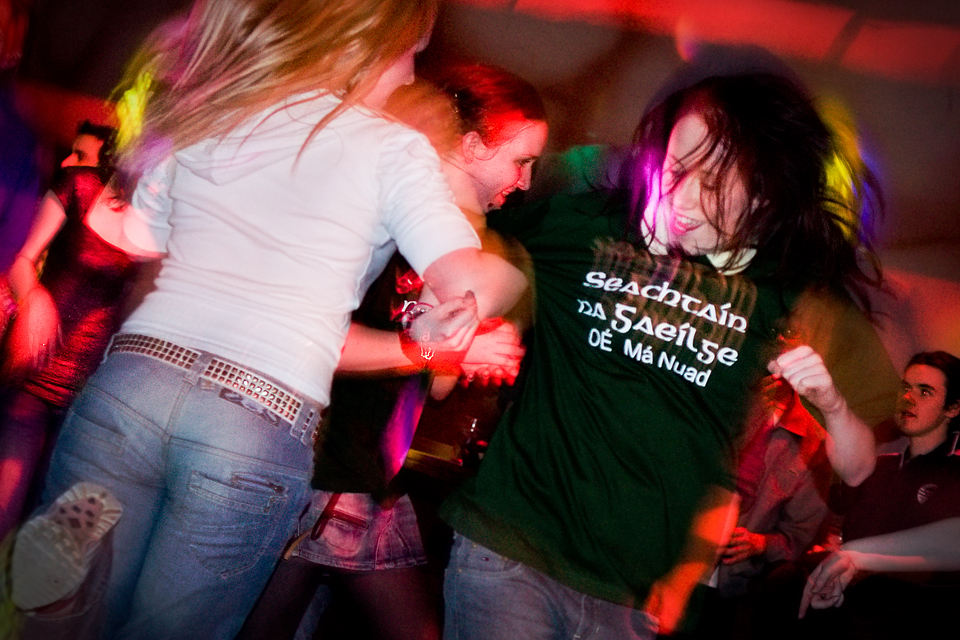
Everyone is trying to be different, in order to make a difference. As I’ve pointed out many times, in order to stand out, you should try to take photos from a different angle or view point.
Here’s a classical one: the rear-view. Instead of photographing the action, from the back, over people’s heads — photograph the people, from the front, watching the action. While we’re not talking video here, this kind of reminds me of those funny clips of tennis spectators watching a game and their heads turning left-right-left-right at the same time.
So this photo was taken at the “election party” for the German general elections two weeks back, organised by the Goethe Institute Dublin and the German Embassy (which has three of my photos from the event on their website). People were pretty much on the edge to see what the outcome would be (and rightfully so, general elections only happen every four years!), you could almost think they were watching a game of soccer…
It was a great evening even if things didn’t turn out the way I personally would have liked them to be (politically), especially with all the delicious typical German food on offer! So thanks to the Goethe Institute, the Embassy — and ultimately the German tax payer ;-)
| Focal length: | 17 mm |
| Aperture: | ƒ/4.0 |
| Exposure: | 1/80 s |
|
|
Posted at 18:02

And now for a more abstract shot again, which I took about a year and a half ago.
As you probably already guessed, it shows a spider web covered with ice crystals. Nature at its best produces these typically in the winter time, combining thick fog with freezing temperatures.
Technically it was quite hard to shoot, as my fingers were pretty much frozen after a few minutes… No, but seriously now, although the crystals were very pretty and all it was rather difficult to make them look good on silicon. I experimented a bit and ended up using a flash gun directly below the net shooting straight up.
This not only gave the crystals nice “three dimensional” character, but it also helped to pretty much remove the (fairly cluttered) background of the student residences’ rubbish dump…
Just like now, I think I got a cold out of this shot.
| Focal length: | 180 mm (≈270 mm) |
| Aperture: | ƒ/9.0 |
| Exposure: | 1/250 s + flash |
|
|
Posted at 21:15

Back from our little honeymoon, here’s a new post with a fresh picture from València (Spain).
I took this photo on the social “outing” from the POSTA ’09 conference, where we visited the Ciutat de les Arts i les Ciències (City of Arts and Sciences), an area right in the city where different buildings, such as opera, science museum, IMAX, etc. compete for the most futuristic look. It quite reminded me of Brasília (the capital of Brazil).
Anyway, today’s tip is to take as many photos as you can when you’re in the so-called Golden Hour, the time just before sunset (or just after sunrise, if you fancy getting up early). This gives you some wonderful light to play with and take amazing, moody shots and portraits of people.
Watch your white balance though (!), make sure your camera (when set to automatic) doesn’t compensate for the warm colours, resulting in too neutral a feeling. Either manually set the white balance to something around 7500°K, or use the “sunset” mode /picture style or whatever it may be called.
| Focal length: | 24 mm |
| Aperture: | ƒ/5.6 |
| Exposure: | 1/50 s |
|
|
Posted at 19:26

And off I go again to Spain. Seems like I just left Barcelona yesterday ;-)
This time I’m off to a conference in València (POSTA ’09), and right after that Steffi and I will have a small “Ersatz”-honeymoon since our original plans to go to Hawaii had to change… We’ll have a small roadtrip around the south of the Iberian peninsula.
The photo here was taken on our last Spain trip to Barcelona and it shows one of the narrow streets in the old part of the city. I just loved the warm colours of the buildings, and to intensify that I cranked up the white balance to a fairly high value (must have been above 10’000 °K I think). That’s a very simple but neat trick to add some extra warmth to your pictures without much too much effort. Along the same lines, if you add in some more magenta, you can achieve a more of sunset-y type of flair.
Another common thing done here is the compression of perspective by using a telephoto lens and a fairly long focal length. This additionally reduces the depth of field to highlight two little details in the picture, the wind-wheel-flower and the street light.
Anyway, will be back in a couple of weeks time, hopefully with some more pictures :-)
| Focal length: | 160 mm |
| Aperture: | ƒ/5.6 |
| Exposure: | 1/200 s |
|
|
Posted at 16:43

Most filters (in front of lenses) that people try to sell you don’t make sense in digital photography. In particular UV filters, sky light filters or protective filters — the first two are irrelevant, and you usually protect your lens much better by using a lens hood. All that these “useless” filters do is degrade image quality.
The only two filters that make sense, I guess, are polarisers and neutral density (or just “grey-”) filters. I might talk about the latter at some other time, today’s topic is the polariser. If you don’t have one, get one. Unfortunately, the better ones (that’s the ones you want to buy, since they have decent coatings on them, are more colour neutral and usually live longer) can be quite pricey, especially when you have large lens diameters.
Why? Well, the main effect of these filters is one that you just can’t reproduce properly in post-processing: They reduce reflections. There are mainly two situations where this is important 1) in the sky and 2) on colourful objects (well, actually 3) on translucent surfaces). In the sky the filter gives you much deeper blues as it removes some of the sunlight reflected off the haze in the air (which leaves the deep blue rather “milky”). On objects, such as grass, leaves, buildings, etc. it reduces the reflection of the ambient light to again just give you the actual significantly more saturated colour of the object. Third, it allows you to shoot through windows or water surfaces to reveal what’s behind (again, by cancelling out reflections of the surrounding).
Sounds great, doens’t it? Well, there’s a catch or two. On the one hand, you lose about 1 to 3 stops of brightness. On the other, in order to be able to cancel reflections, you need to get the angles right (this has to do with the physics behind all this). Since the post is already long enough, I won’t go into explaining how exactly to use them — if you’re interested you can have a look at this article for instance, or this page.
As for the photo above — you guessed right, it’s been shot using a polarising filter. No post-processing really, just the filter’s magic :-)
| Focal length: | 18 mm (≈27 mm) |
| Aperture: | ƒ/9.0 |
| Exposure: | 1/80 s |
|
|
Posted at 18:37

Not that this is the greatest photo ever shot (of course I don’t mean the two ladies on it, but in general), there still must be something about this shot that people want to use it… Now there’s two kinds of people: those that want to use it and pay for it, and those that just use it, without paying for it (or even asking permission, for that matter).
Here’s the whole story. I was recently approached by an ad agency who wants to buy a handful of photos of me for use in a prospectus for the university. When the deal was almost sealed, they sent me an email saying that they saw one of the photos they were about to purchase (the one above) in a similar prospectus from another university, and that they weren’t really happy about that (since they thought they are getting the picture “exclusively”, which is the normal thing to assume).
Turns out there are actually two prospecti (?) from Dundalk IT where some of my images are used in. The best bit: They never asked for my permission to print the pictures! This is bad in a number of ways. It’s bad form to start off with, it’s a violation of the copyright I own for the images, it does not honour the licence under which I posted the images on flickr (which only allows for non-commercial use with appropriate attribution only, whereas the ad agency was obviously paid for making the prospectus, and my name was nowhere in it), and last but not least: I don’t have a model-release from the two Erasmus students on it — so if they were upset about their picture being printed in hundreds (or thousands) of leaflets, I’d be in trouble now!
Anyway, I sent an email to the agency about the issue, and they now forwarded me to someone in the university that provided them with the pictures. That person is away until September 1st, so I’ll have to wait and see how they react. I’d be interesting to see what they have to say though…
| Focal length: | 70 mm (≈105 mm) |
| Aperture: | ƒ/4.5 |
| Exposure: | 1/50 s |
|
|
Posted at 16:08
|